




Halting Human Trafficking
“Reporting a concern can be the difference between someone remaining in exploitation and someone being connected to safety.”
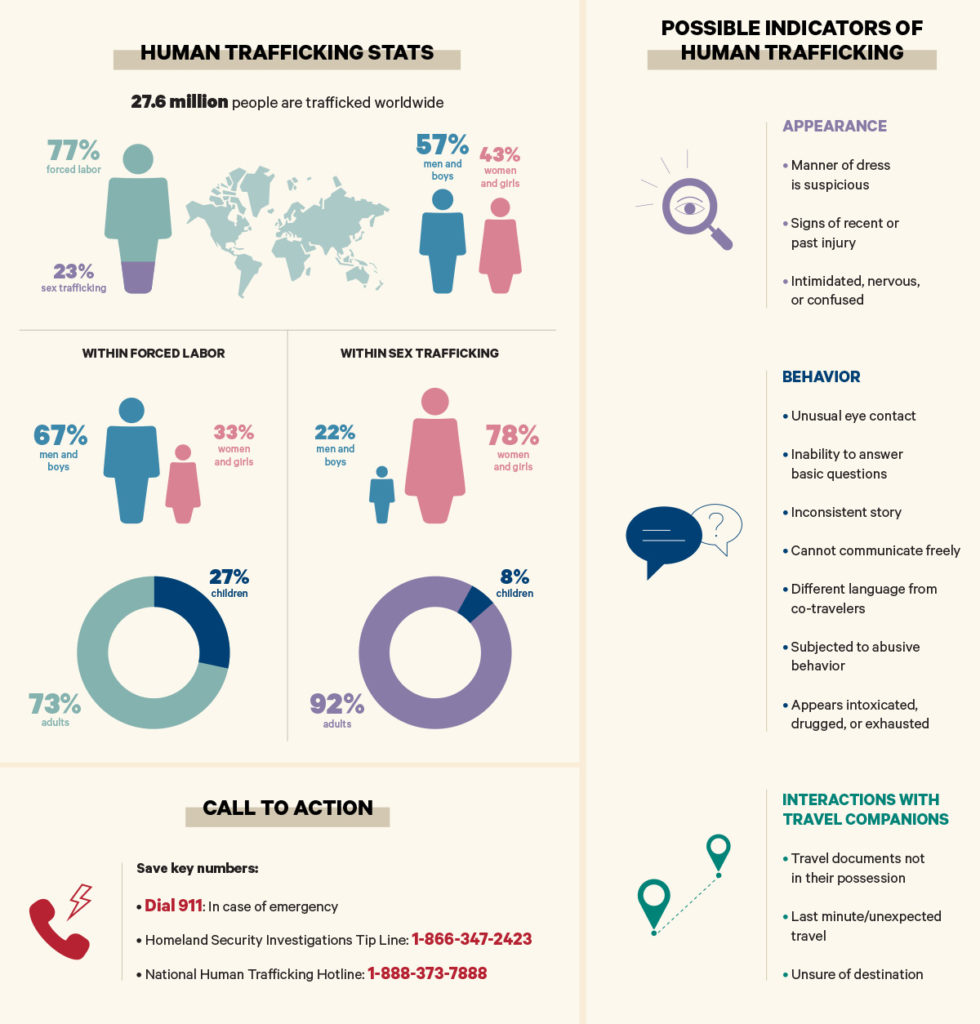
Each year, human traffickers victimize an estimated 27.6 million people, according to the United Nations’ International Labor Organization. Criminals force thousands of people in the United States to remain captive in forced labor or sexual exploitation. Human trafficking occurs in the shadows, making opportunities to identify and rescue victims precious and few. Of the limited places where such interventions might occur, public transportation hubs such as airports and train stations are the most promising.
According to the Department of Homeland Security (DHS), 80% of international human trafficking cases crossed official ports of entry by bus, train, boat, car and airplane. In a DHS study, 38% of 104 survivor respondents indicated that commercial and private airplanes were used as part of their exploitation.
On January 12, the Metropolitan Washington Airports Authority (MWAA) held its annual Human Trafficking Awareness event at Washington Reagan National Airport. The event informs attendees about the problem of human trafficking, how to combat it, and about a local non-profit on the frontlines of the effort. This year, MWAA highlighted The Salvation Army, especially its Catherine’s Cottage, which has provided resources and safe shelter for human trafficking victims since 2017.
“Human trafficking is a profound violation of human dignity,” said Major Wilma Mason, area commander for National Capital Area Command (NCAC), who gave remarks to the gathering. “It is hiding in plain sight, all across the country, right under our noses. It is an issue that demands our attention, our compassion, and, most importantly, our action.” In 2025 alone, The Salvation Army in the United States served nearly 3,000 survivors of human trafficking through 32 human trafficking response programs.
The USA Southern Territory and the Potomac Divisional Headquarters supported the NCAC at the event with several officers and staff members in attendance. Sheena Evans, territorial services coordinator against human trafficking, spoke to the promise of partnering with the DHS’s Blue Campaign, “If we can put awareness in as many places as we can, not only the airports but when it comes to Uber and Lyft, and do it strategically … and better partner as a Salvation Army, it’s going to be a great national effort.”
Blue Campaign works closely with DHS Components to promote general awareness training and educational materials to help reduce victimization within vulnerable populations. An element of the Blue Campaign, Blue Lightning, trains aviation personnel to identify potential trafficking and report their suspicions to federal law enforcement. Representatives for Blue Lightning provided training during the MWAA’s awareness event and distributed informational materials.
During the event, a lived experience expert shared their powerful story and insights from their experience of human trafficking. They described how traffickers use tactics of manipulation and deception to keep victims controlled and trapped. Lieutenant Mandre Boggess, commander of the Criminal Investigations Division with the MWAA, urged anyone seeing something suspicious to report it to police, even if they’re unsure of what they’re seeing. “Reporting a concern can be the difference between someone remaining in exploitation and someone being connected to safety.”
When asked what motivates her to combat human trafficking, Evans described her life’s passion, “I want to see people free … I want to see people understanding their true identity and who God has called them to be.” In an era when hyper-wealthy elites trafficking young men and women makes front-page news, the problem of human trafficking appears as dire as ever. The fight for freedom enlists all Americans and calls people to be informed and alert.
Photos: piranka/Getty Images, _human, A Mokhtari, calvindexter/Getty/Illustrations by Hana Seo